

What Vanilla Forums is, and who it suits
Vanilla Forums grew up as forum software and became better known as a hosted community platform for businesses. It is now sold as Higher Logic Vanilla, described by its vendor as customer community software, so check the vendor’s site for what is on offer today. People still search for it as Vanilla Forums, and this page uses that name for that reason.
It suits an organisation that wants a vendor to run the community. Think of a software company with a customer forum, or a brand with a few thousand members and a team that would rather not look after servers.
For that buyer, a managed service with support and a contract is the product. It is a reasonable thing to pay for.
The real difference: someone else runs it, or you do
Most of this comparison comes down to one choice. With a hosted enterprise platform, the vendor owns the infrastructure. You configure it, you moderate it, and you pay for the service.
With Jetonomy, you own the site. The forum is a plugin on your WordPress install, the data sits in your database and the pages are on your domain. You decide when to update and where to host, and you carry the responsibility that comes with that.
Neither arrangement is better in general. A hosted platform buys you time and accountability. A self-hosted plugin buys you control, a smaller bill and a forum that shares your login and theme.
What you take on when you own the community
A managed platform sells you time. Owning the forum gives some of that time back to your team, so be honest about who gets it. A normal week is small, but it is real.
Someone reads the moderation queue and acts on flags. Someone answers or routes the questions that have no accepted answer. Someone applies plugin updates, ideally on staging first, and checks that a backup exists. In a company, that is usually a few hours a month for the person who already runs the WordPress site.
Access is the other thing you now own. Keep the list of administrators short and use per-space moderators for everyone else, since a mistake by an administrator touches the pages of your site as well as the forum.
If nobody on the team can own that, plan for it before you leave. The weekly moderation workflow shows a routine you can repeat each week.
Setting up a customer community, step by step
For a support-led community, the order below gets you to a working space quickly. Each step is free unless it says Pro.
- Install Jetonomy and run the setup wizard. It asks for a community address and a default community type.
- Create a Q&A space for support and an Ideas space for feature requests.
- Make a private space for customers only, and gate it with MemberPress or Paid Memberships Pro if access follows a purchase.
- Set your moderators for each space, and choose how new accounts start.
- Add Pro for the pieces a customer community often needs, such as custom fields, analytics, webhooks and advanced moderation rules.
- Announce the forum from your product and help pages.
What it costs you to run each
A hosted enterprise platform is sold on a quote or a plan. Check the vendor’s site for current terms, because they change. What you get for that money is infrastructure, upgrades and a team on the other end.
Jetonomy has a free core plugin, and Pro starts at $69 a year for one site. You pay for your own WordPress hosting, which you probably have already. You also take on the work: updates, backups and watching the moderation queue.
Be honest about who does that work. If your team already looks after a WordPress site, it is a small addition. If nobody does, a managed platform may be cheaper than it looks, once you count the person-hours.
It is also worth asking how you will handle a busy period. Jetonomy stores its data in dedicated indexed tables and uses Redis or Memcached when your host provides one, but your host sets the ceiling. A vendor-run platform sells that headroom as part of the service.
Moving over, and what does not come with you
No importer exists for Vanilla Forums. Jetonomy imports from bbPress, wpForo and Asgaros only, and moving from anything else is a manual rebuild or a custom script. A developer can build that against the REST API or WP-CLI, but it is not built in.
Before you commit, work through this list:
- Ask the current vendor how you can export your content and member list.
- Decide which discussions are worth carrying over and which can stay archived.
- Plan for members to sign in with a WordPress account on the new site.
- Set your own redirects, because none are created for you.
The migration guide covers the approach for a manual move, and the Q&A and accepted answers page shows how a support space is laid out.
A support community and a roadmap on your own site
Many hosted communities are used for two jobs: answering customers and collecting ideas. Jetonomy covers both with space types.
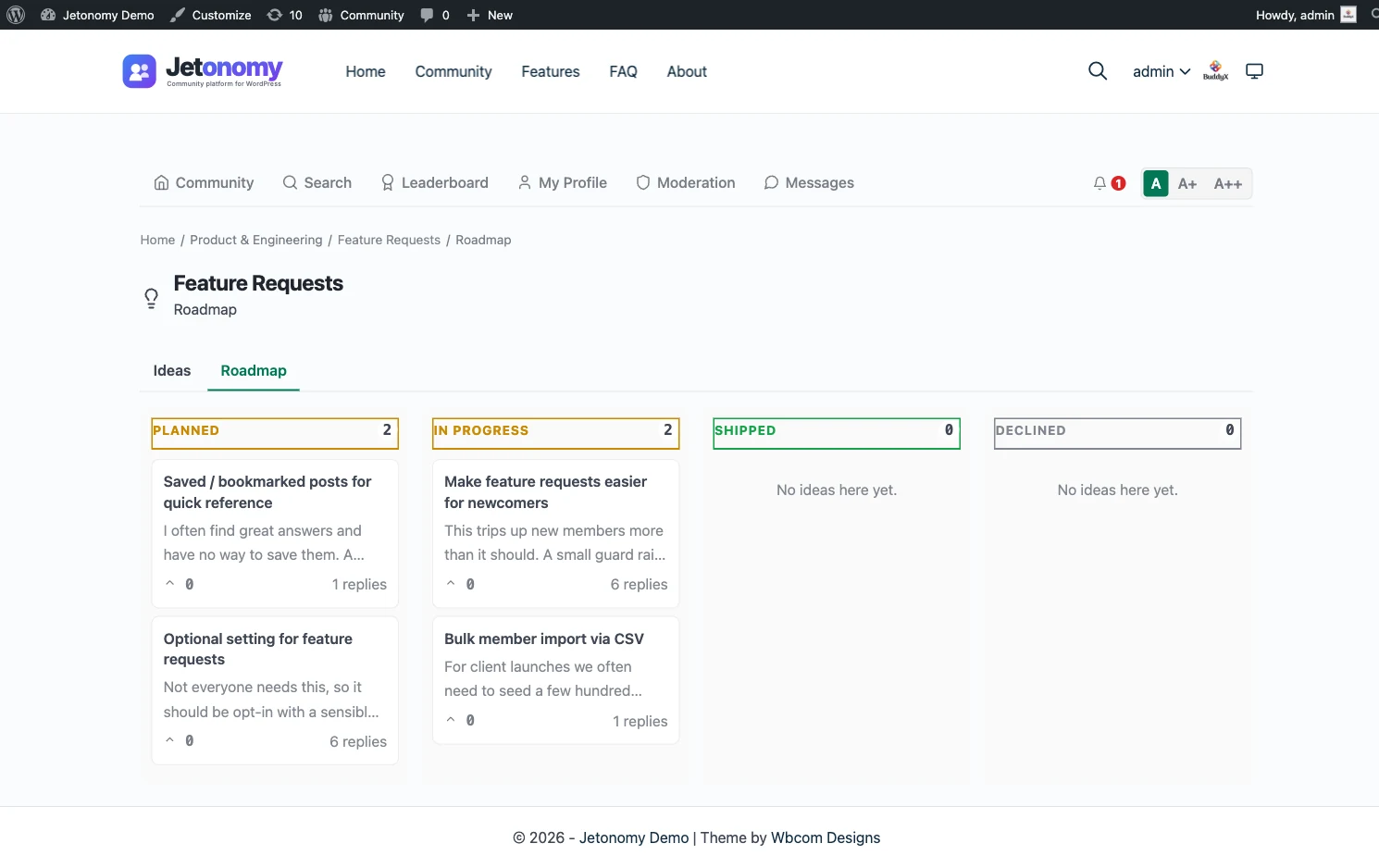
A Q&A space gives each question its own page, lets replies be voted and lets one be marked as the accepted answer. An Ideas space adds voting and a status roadmap, so members can see what is planned, under way or done. The ideas and roadmap page shows the flow, and it shows how a product team can use it.
Moderation is built in as well. There is a queue for flagged content, per-space moderators, ban and silence, and trust levels that limit what new accounts can do.
What Jetonomy does not do for a hosted-platform buyer
A managed service bundles things that a plugin leaves to you.
- Hosting, backups and uptime are yours or your host’s. Jetonomy does not run the servers.
- There is no Vanilla Forums importer. A move is a rebuild or a developer’s script.
- Connections to other business systems are built with webhooks (Pro), the REST API or a developer. Check the partners page for what is listed.
- Members, passwords and subscriptions do not transfer, and no redirects are created.
- There is no live chat, voice or video.
None of that is hidden, and it is the honest cost of owning the site. Count it against the value of control and a smaller bill.
Your data, and your exit
Owning the forum means the data sits in your WordPress database, on a host you chose. Members are WordPress users, and WordPress’s own export and erase tools handle personal data requests. Members can delete their own account and data.
Members can export their own data and delete their own account, and export and erase requests run through the standard WordPress privacy tools. A data request therefore stays inside the site you already manage. Nobody has to open a ticket with a vendor and wait for an answer before replying to the member.
It also means you can leave. A developer can read everything over REST or WP-CLI. A hosted contract usually asks you to request an export, so ask any vendor what format you would get before you sign.
A first thirty days checklist
- Week one: soft launch to a small group of real customers and fix what confuses them.
- Week two: seed the Q&A space with your best support answers, each as a question with an accepted answer.
- Week three: open the Ideas space and post the first roadmap items.
- Week four: review the queue, check analytics if you have Pro, and announce the community more widely.
The forum, Q&A and ideas guide helps you pick the right space for each job, and the support forum journey follows one end to end.
What you can see about your community
A managed platform often comes with reporting. With Jetonomy, the free plugin shows reputation and a leaderboard, and moderators see the queue and the activity log. Pro adds analytics, which shows what is being read and who is reading it.
If your business depends on dashboards for a customer success team, decide what you need before the move. Where analytics falls short, the REST API and webhooks let a developer feed numbers into the tools you already use.
Questions to ask, of a vendor and of yourself
A move is easier when the questions are on paper.
- What format will the current vendor give you for an export, and how long will it take?
- Who will answer the questions the community raises, and is that person named?
- What does a bad day look like, and who is on call when the site is slow?
- Is the contract date a reason to move, or a reason to wait?
None of these has a single right answer. A quick, honest pass often shows that a managed platform is still the better choice for one team and not for another.
Branding it as your own
A hosted platform often sells branding as a feature. Here it is mostly settings you control. The free plugin follows your theme’s brand colour, and logo, accent colour and email branding are free settings. Templates can be overridden from your theme if you want to go further.
Pro white label is narrower than the name suggests. It changes the admin-side labels, such as the menu name, icon and footer text, and does not alter the front end. So a customer-facing community looks like your site because it is your site, not because a switch rebrands a vendor’s product. The white label page lists exactly what changes.
A family of plugins, not a single contract
Jetonomy sits alongside other separate, optional plugins from the same team. They share one WordPress site and one login, and you add only what you need.
BuddyNext is the social layer, with profiles, an activity feed and groups. When both are active, the forum adopts BuddyNext’s look and BuddyNext owns the page header and navigation, with nothing to configure. On that site BuddyNext also owns messaging, so members get one inbox. See the BuddyNext page. It suits a brand community that wants people to have profiles and a feed as well as threads.
Learnomy is the LMS plugin. With Jetonomy Pro, a space can be gated by a Learnomy course or membership plan; enrolling adds the member, expiry removes them and their posts stay. That fits a training community where access should follow enrolment. See the Learnomy page.
The same team also makes WP Career Board for jobs, Listora for a directory, Eventonomy for events with RSVP and capacity, WPMediaVerse for member media and WB Gamification for points and badges. BuddyX Pro and Reign are themes from the team.
A hosted platform puts these in one bill under one contract. Here they are separate plugins that you install, host and update yourself, which is more work and more freedom. None of them is required, and a forum-only site is a perfectly good outcome.
Other Vanilla Forums alternatives worth a look
A hosted enterprise platform has plenty of neighbours. These are the ones worth knowing:
- Invision Community is a commercial suite that you can host yourself or have hosted, with a wide set of built-in apps.
- Discourse wins when you want a mature standalone forum and have infrastructure people.
- Circle is a hosted community and course platform for creators and small teams.
- Mighty Networks suits a paid, mobile-minded membership community run as a service.
- Flarum is a lean open-source forum app if you want standalone but self-hosted.
- bbPress is the simplest forum that lives inside WordPress.
A vendor-run platform is the right call in several of those cases. Jetonomy is for people who want to own the forum.
Who should stay with a hosted platform
Stay if a service agreement is a requirement, or if your organisation will not run a WordPress site at all. Stay if the community is large, your team is small and you value having a vendor to call.
Stay, too, if the platform already works and the cost of moving outweighs the saving. If you want to see what a self-hosted version would look like first, the features overview is a good place to begin.